the fiction-perspective continuum
In sci-fi, these charts can help you find similar authors to clarify your own perspective.

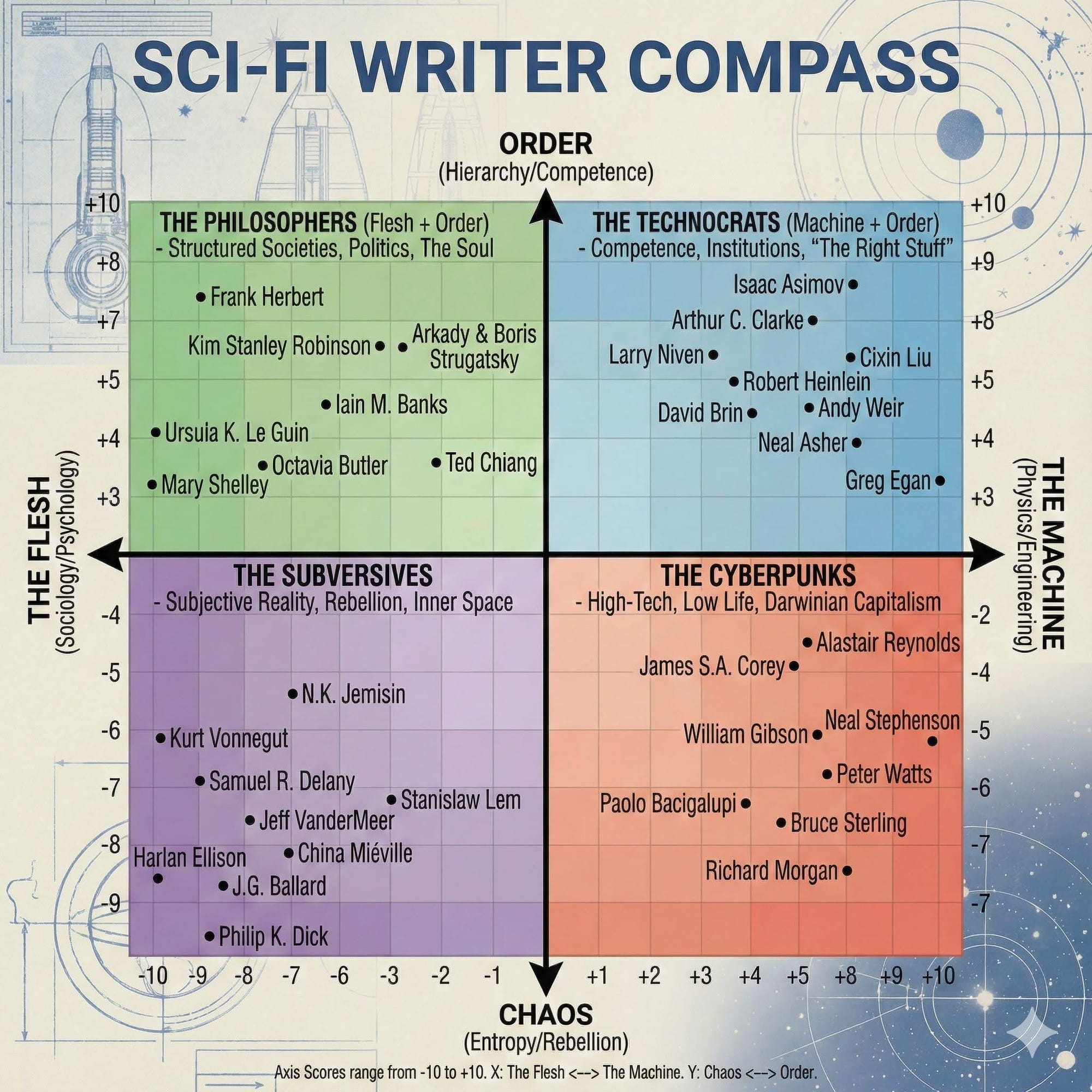
Versions of this chart have been going around in different Facebook groups. This particular chart categorizes sci fi authors against the opposites flesh vs. machine, and order vs. chaos:
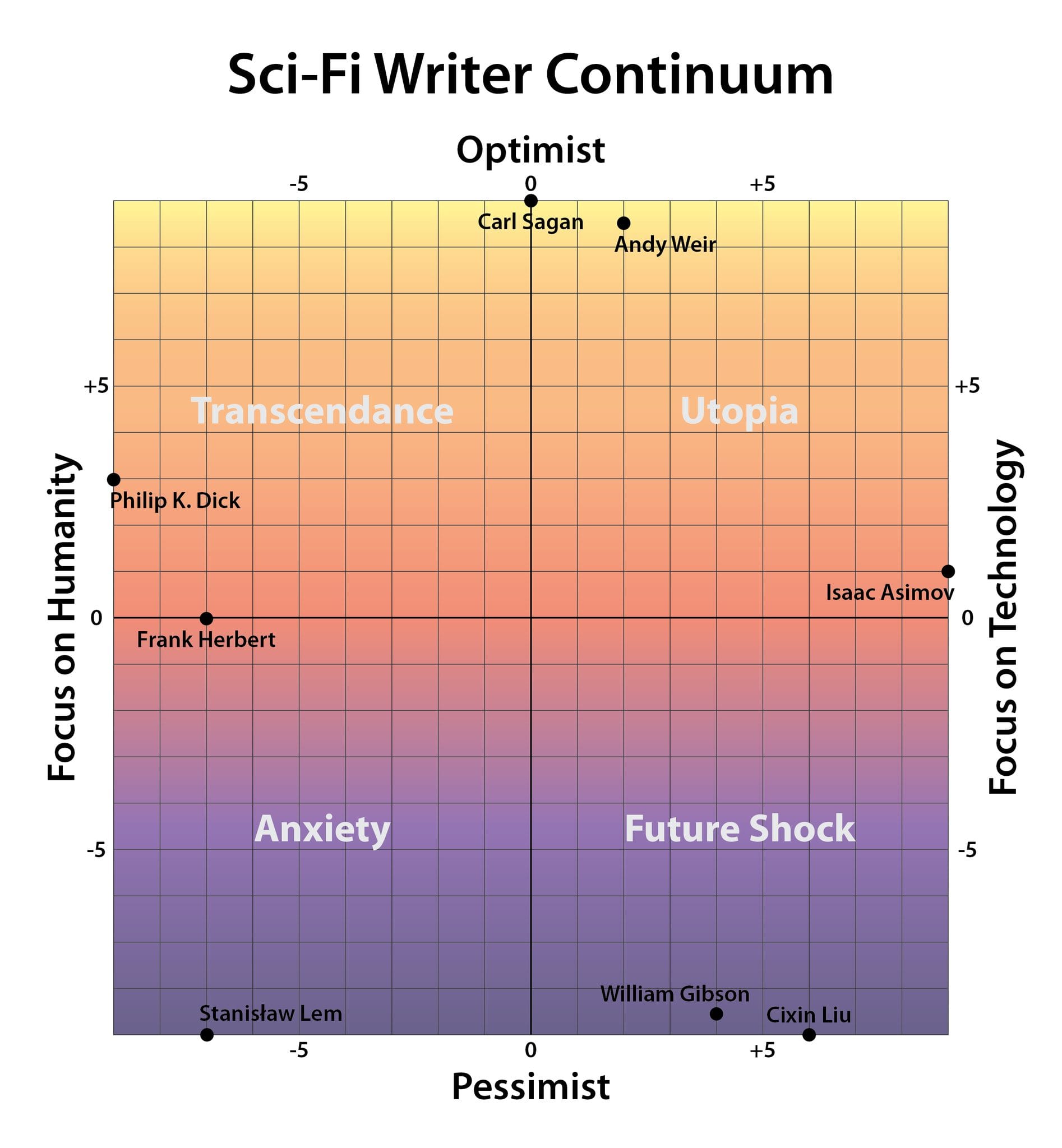
The other chart I saw is similar, and not completely filled out yet. Instead of order vs. chaos, it's optimistic vs. pessimistic:
Any writer narrowing in on a genre needs to first understand what kind of stories they want to tell. To that end, I'm trying to get a clear picture of which authors tell the same kinds of stories I like. Ideally, I should know those stories and authors very well and then try very hard to do something new that offers a new take on the genre.
Uh-huh. Harder than it sounds.
points of reference
I read a lot of sci-fi, or try to. I've been a part of a science fiction book club for almost a decade and the variety of books we've read over the years has pried open my mind to what makes a good story in science fiction. A few of my favorites were All The Birds in The Sky (science meets magic), Martha Wells' All Systems Red (goofy self-aware robot), and Andy Weir's Project Hail Mary (speculative, but realistic sci fi).
All were excellent reads for different reasons. In particular, Weir is especially gifted at making his stories feel so real that I found myself putting his book down to relish a moment in the story. That is great writing.
consider banks
The kind of sci-fi that really calls to me is the likes of Iain M. Banks' Culture novels. His books are meaty, well-written, and have epic world-building set in a post-scarcity world. I mean, holy shit, just read this passage from Consider Phlebas:
General Systems Vehicles were like encapsulated worlds. They were more than just very big spaceships; they were habitats, universities, factories, museums, dockyards, libraries, even mobile exhibition centres. They represented the Culture—they were the Culture. Almost anything that could be done anywhere in the Culture could be done on a GSV. They could make anything the Culture was capable of making, contained all the knowledge the Culture had ever accumulated, carried or could construct specialised equipment of every imaginable type for every conceivable eventuality, and continually manufactured smaller ships: General Contact Units usually, warcraft now. Their complements were measured in millions at least. They crewed their offspring ships out of the gradual increase in their own population. Self-contained, self-sufficient, productive and, in peacetime at least, continually exchanging information, they were the Culture's ambassadors, its most visible citizens and its technological and intellectual big guns. There was no need to travel from the galactic backwoods to some distant Culture home-planet to be amazed and impressed by the stunning scale and awesome power of the Culture; a GSV could bring the whole lot right up to your front door...
One part inspiring, two parts demoralizing... Banks was so good at creating this stuff that I wonder how I could ever top it. I might not ever get there.
not stinky, either
Science fiction isn't my only literature reference point, though. There are some writers whose work is so exceptional that they are almost lyrical. Like this opening paragraph from Patrick Süskind's Perfume: The Story of a Murderer. Even translated from German, it feels like a miniature masterclass for how to set up an intriguing premise while suggesting the story's cultural backdrop:
In eighteenth-century France there lived a man who was one of the most gifted and abominable personages in an era that knew no lack of gifted and abominable personages. His story will be told here. His name was Jean-Baptiste Grenouille, and if his name—in contrast to the names of other gifted abominations, de Sade's, for instance, or Saint-Just's, Fouché's, Bonaparte's, etc.—has been forgotten today, it is certainly not because Grenouille fell short of those more famous blackguards when it came to arrogance, misanthropy, immorality, or, more succinctly, to wickedness, but because his gifts and his sole ambition were restricted to a domain that leaves no traces in history: to the fleeting realm of scent.
i might be... chaotic good?
Coming back to the chart above, I'd definitely place myself closer to machines than humanity, but not all the way at +5—I think technology has the potential to let humans be more fully human, instead of making humans technologically dependent. A future where machines do all the degrading work and humans make inspirational art all day feels closer to utopia than dystopia, right?
As for optimism vs. pessimism, I'm definitely more of a pragmatist who leans toward optimism in the long-term. I prefer stories where people don't have to do good because it's lawful, but because it's the right thing to do. And over time, I think those kinds of battles are eventually won. Call me naïve, but that's my bias, I guess.
bonus tips for writers
Study writers you like. What are most of their stories about? What are the common tropes people expect to see? How can you tell a common story in a new way nobody has ever told it before? Or can you tell a story few writers cover that still lands in the same genre? Even further, what makes your story completely unique to you? The more unique you make it, the closer you'll get to crafting classic literature... which is considered classic because it is timeless, i.e., it evokes a universal feeling from a highly unique circumstance.