1 Goal. 64 Actions.
Having a simple and beautiful system to track how to accomplish big goals is mission critical. This is a pretty good one.

While on holiday last week, I stumbled across the brilliant Harada Method, an organizational method to help execute strategic goals by including the "human side" to continuous improvement. I'd already been a huge fan of Kaizen which Toyota used to make its factories run more smoothly, but the Harada Method takes Kaizen the next logical step by emphasizing each person's "self-reliance so they can become so skilled at something that he or she is virtually irreplaceable."
I had already heard about the knockout success of Japanese baseball player Shohei Ohtani, but I hadn't heard about how. Apparently, he used this (relatively) simple system when we was only a high school sophomore to execute his plan to "get drafted 1st overall (8 teams)." When he joined the American Professional Baseball League in 2018, he was rumored to be worth $300 million.
The "OW64-Chart", Ohtani's Secret Weapon
The Harada Method employs a various collection of feedback forms (Routine Tracking, Daily Diary, 33 Questions) that all work in unison, but it was the Open Window 64 Chart (or "OW64-Chart") that grabbed my eye.
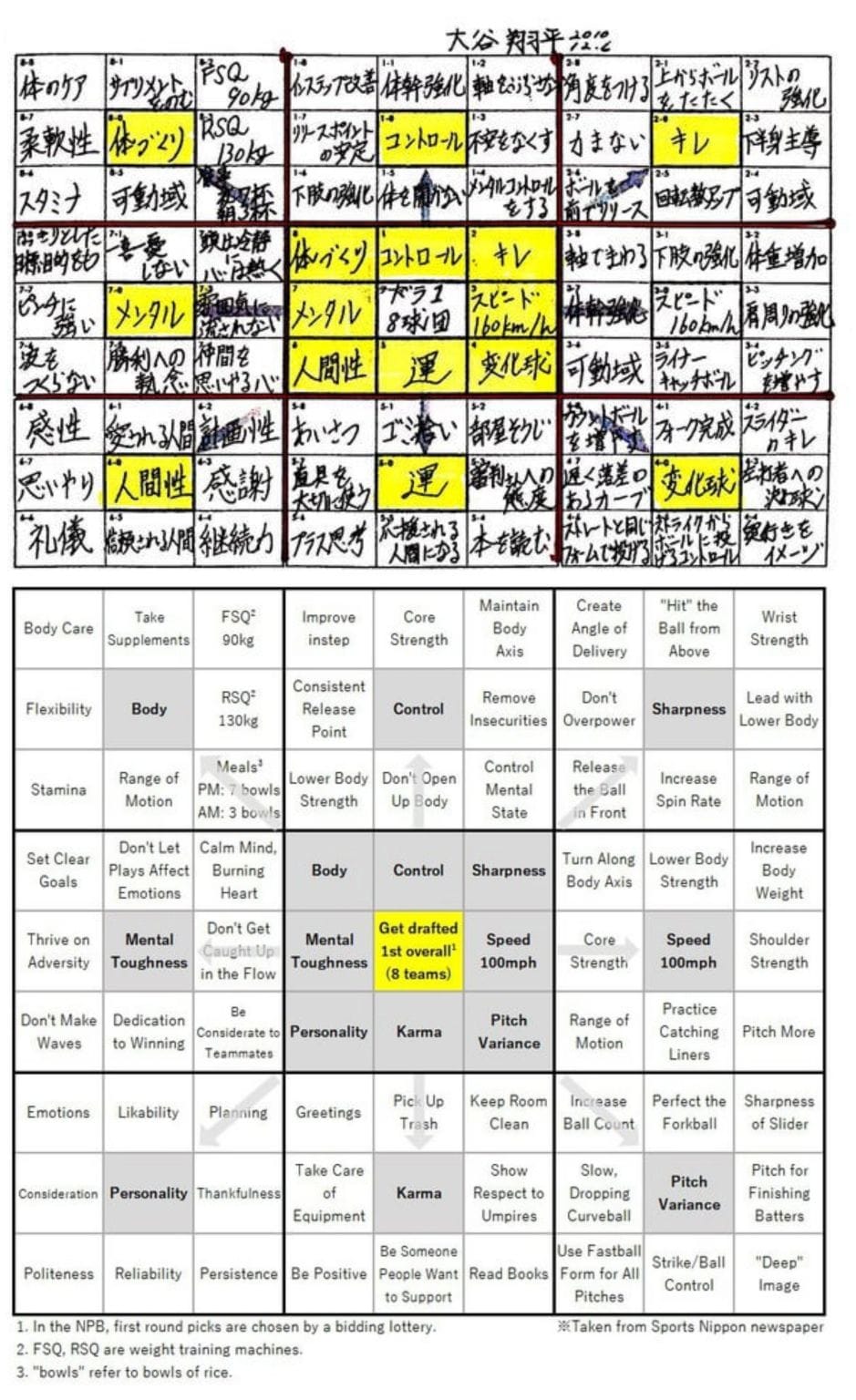
At first glance, the OW64-Chart looks like a text-only version of Sudoku with the center box containing a big central goal surrounded by eight "support pillar" goals. The support pillars are copied into its surrounding 3x3 boxes, and each 3x3 support pillar is surrounded by eight sub-tasks. Ohtani's original OW64-Chart is pretty cool to look at:
How to use the Harada Method is straightforward:
- Pick a central goal you want to achieve and clearly define it, including by when it should happen. (A central goal is typically set 3-24 months out, though shorter time horizons need fewer sub-tasks, e.g., 3 month goals might need only 36 tasks, not 64.)
- Break the central goal into eight support pillars, or 'focus areas', which contribute to the central goal. Support pillars are mostly tangible actions but some goals can (and should) be intangible areas, such as 'motivation'.
- For each support pillar, list eight sub-tasks.
- From all 64 sub-tasks, only pick the top 10 that give the most leverage and convert those into daily or weekly routines (or milestones).
- Focus all your energies into completing those routines.
- After each sub-task has either been completed (milestone) or has become part of your habits (routine), replace that sub-task's routine in your top 10 with another sub-task from your OW64-Chart.
I love the simplicity of this. It forces you to clearly define one big goal and a limited number of medium goals. Without that last constraint, I could see myself listing 20+ medium goals... which is exactly what this constraint is keeping you from doing. (You could always do 20+ medium goals if you really wanted to, but only after you do the first 10 routines from the top 8 focus areas. In theory, you shouldn't have do that since any other focus areas should have less leverage than the top 8 you've already selected.)
However, it is the simple design of the OW64 that I adore... a symmetrical and single-page color-coded visual framework designed for daily review. Since it limits you to only ten sub-tasks for daily or weekly routines, it never feels overwhelming. Achieving the central goal suddenly feels like a big game of tracking consistent daily actions. Meaning, the gamification aspect is what makes it work so well.
As Atomic Habits author James Clear put it, "You don't rise to level of your goals, you fall to the level of your systems." Making a habit-tracking system fun means everything is more likely to be completed, right?
The OW64-Chart for my Debut Novel
I chose to adopt this method until October 1... just under 70 days away. It took me a solid week to hammer out my own OW64-Chart—I had to do some deep thought to figure out the most appropriate support pillars and their sub-tasks, but my central goal was already very clear:
Write and publish an award-worthy action-packed emotional and epic sci-fi spy novel on Amazon KDP by October 1, 2026.
That central goal has eight support pillar goals. These focus areas were pretty easy to figure out, though still not always so obvious:
Complete Manuscript
Plot Structure & Pacing
Dialog & Voice Distinctiveness
World Building Depth & Coherence
Epic & Memorable Sci-Fi
Pre-Launch & Launch Day
Love What You Do
Literary Quality
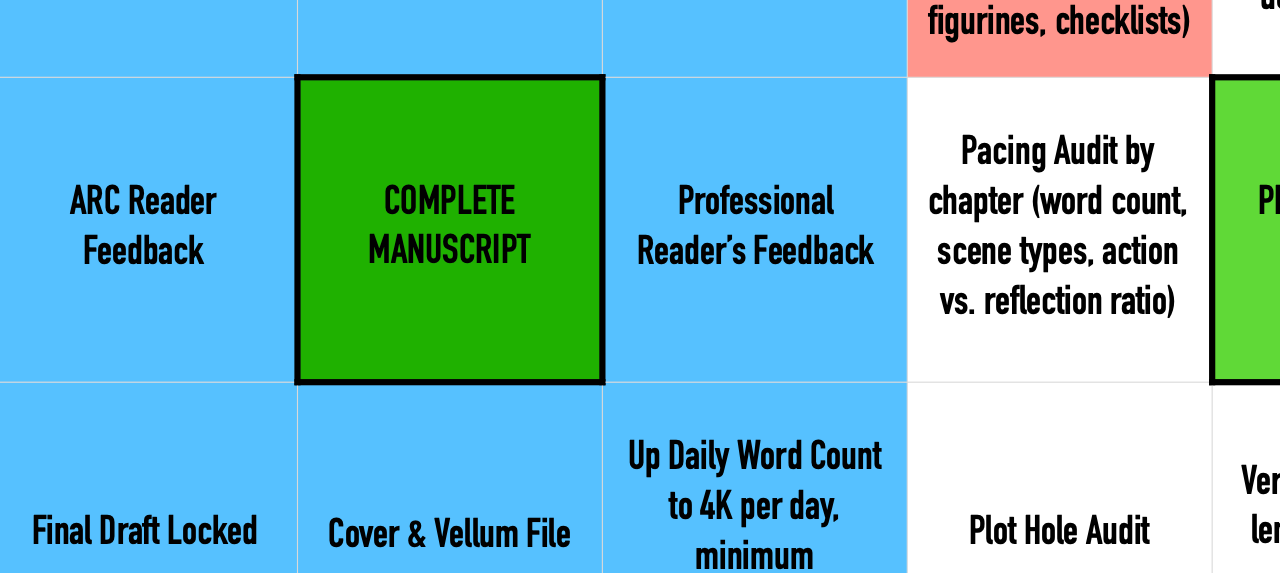
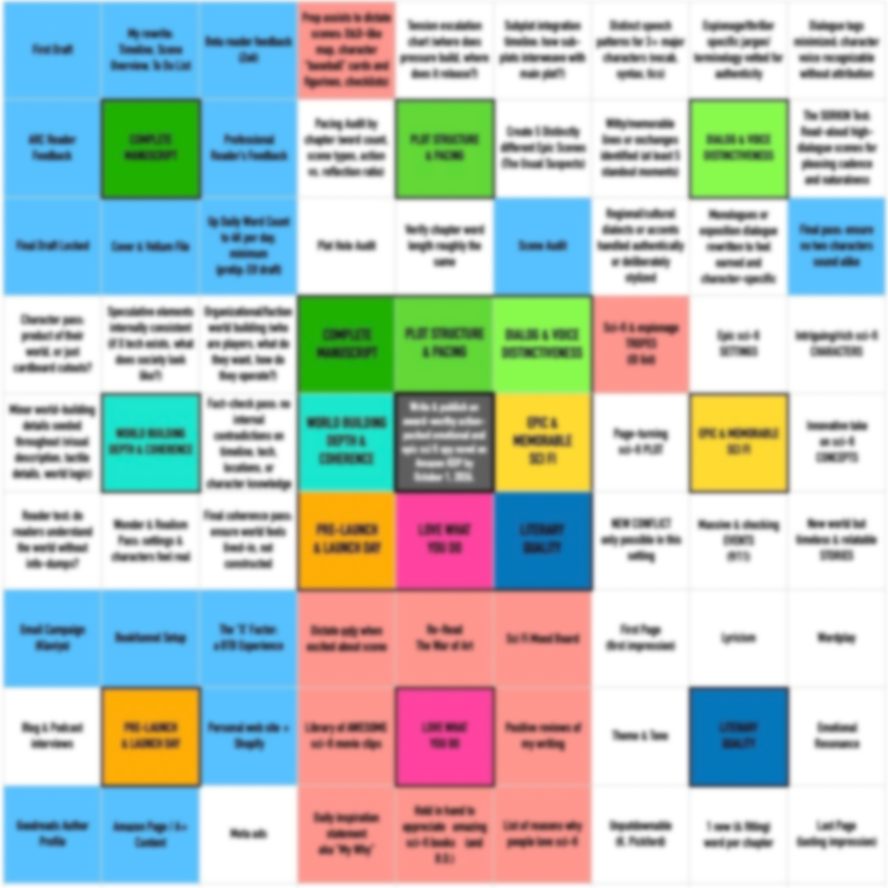
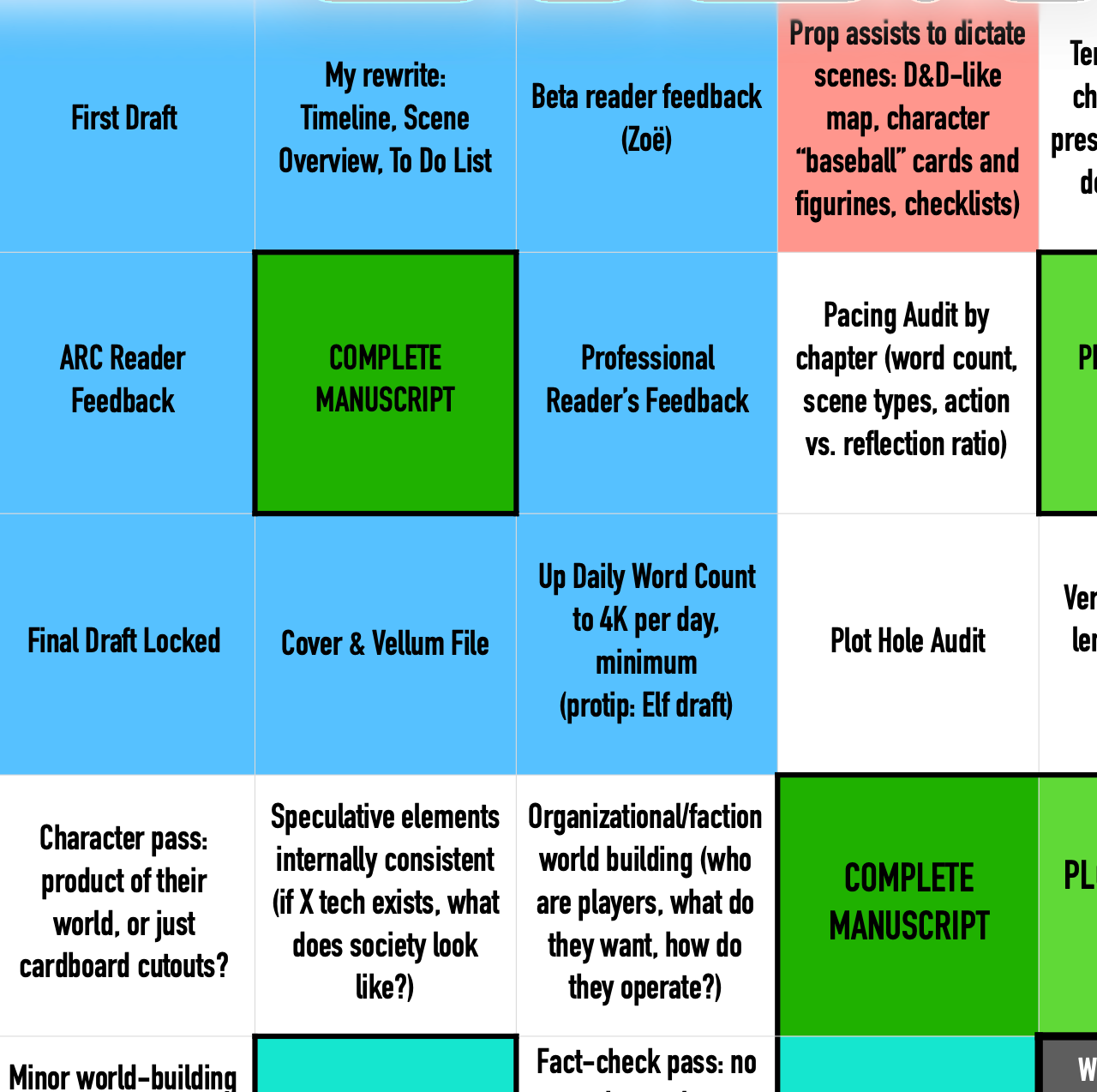
Here's a blurred-out version of my own OW64-Chart (I only blurred it out because some sub-tasks are a little private). Boxes shaded light blue are milestone events and boxes shaded rose pink are top-10 actions.
Okay, okay... here's a closeup of the top left support pillar:
The next three steps after doing the OW64 are:
- Convert all 64 sub-tasks into routines or milestones, assign due dates, and sort them all so you know when each sub-task needs to happen.
- Pick your top 10 routines/milestones based on due dates and/or importance.
- Track those top 10 sub-task routines and milestones.
Tracking with an iPhone Wallpaper
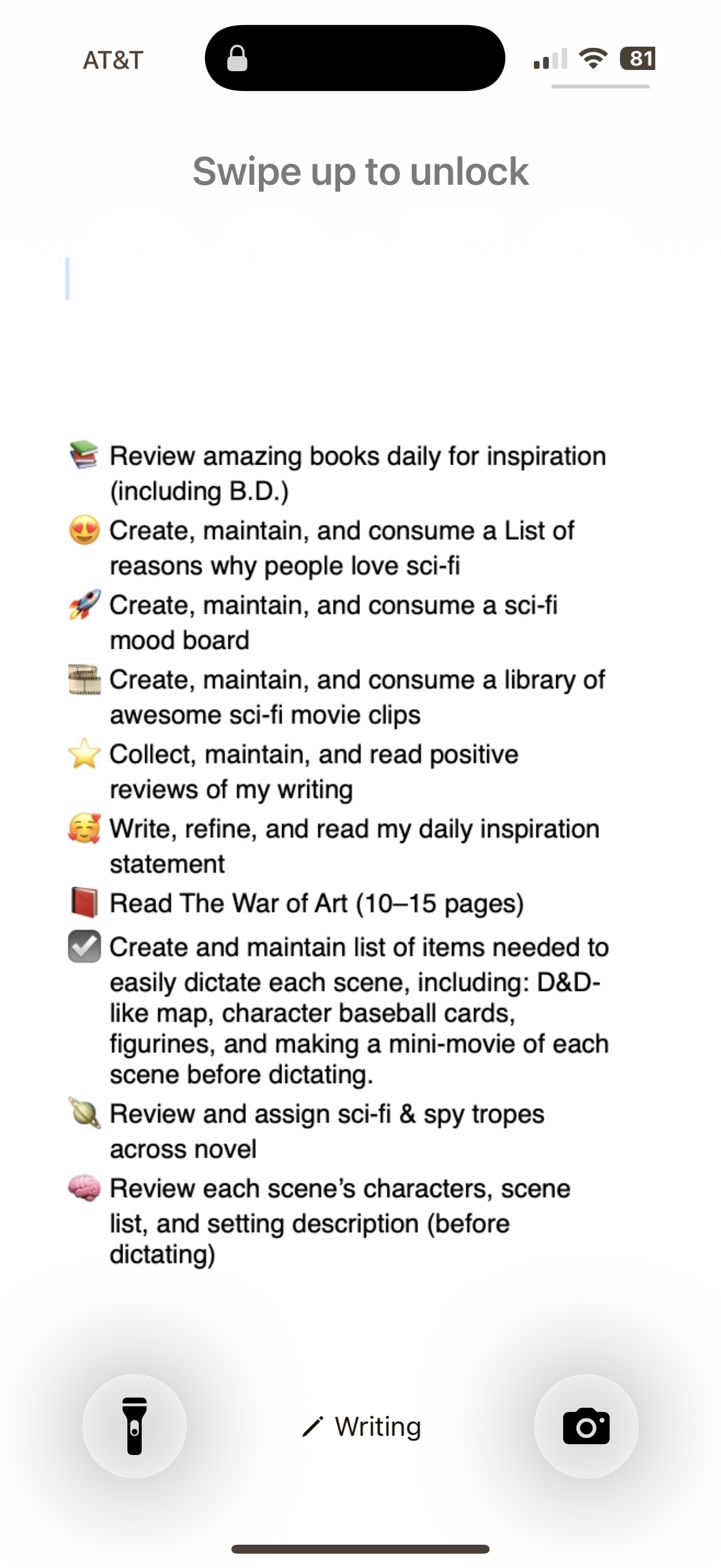
This is the killer supercharger step designed for my ADHD brain. I tend to forget tasks unless they're right in front of me (lovingly referred to as the "invisible shelf" 🙄). With that firmly in mind:
- I laid out all top 10 sub-tasks in a text document with narrow margins.
- I assigned a preceding emoji to each task to visually track them more easily.
- I screen-capped that text doc.
- I added that screen-capped text doc as a wallpaper background for my iPhone.
- I set that background to only appear when I turn on my "Writing" focus mode.
The final result (which I see whenever I hold my phone in Writing Focus mode):
Tracking With a Dedicated Habit Tracking App
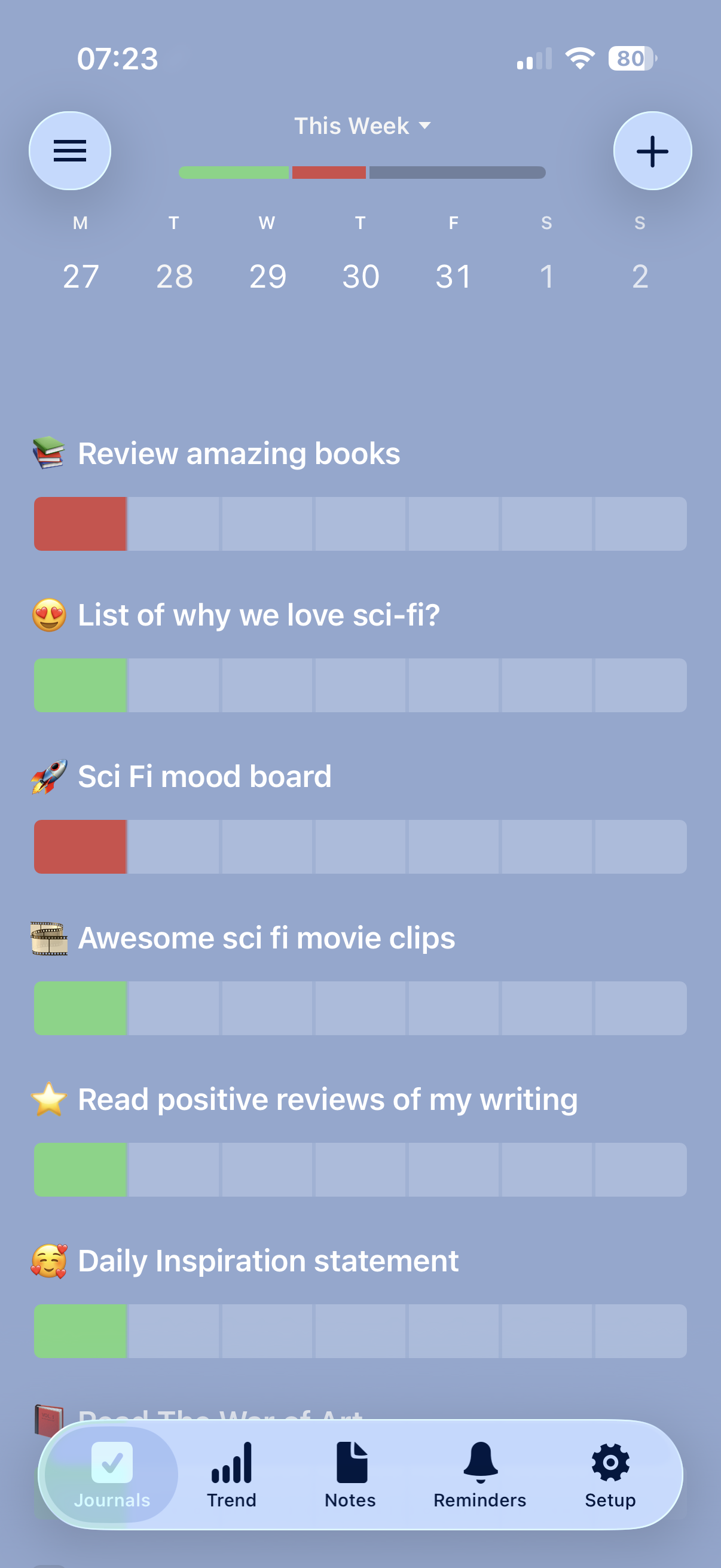
Finally, I pasted all "top 10" sub-tasks into the Way of Life app on my iPhone. This habit tracking app (which is simple and superbly designed) is only for tracking my top 10 routines. Whenever a sub-task is complete (i.e., a milestone is completed or a routine is established), it gets archived and a new sub-task gets promoted into the top 10, both as a new item on my iPhone wallpaper and on Way of Life.