Sell (The Story Behind) The Product
Now that products cost more to produce than ever, how can local businesses compete with online retailers and big franchises?


Today someone posted on Facebook about how high prices of running a business have raised the cost of goods sold: employee taxes, benefits, insurance, gas, supplies, equipment, repairs, licensing, etc. It's all gone up over time. Sadly, customers don't often see that connection when shopping.
This particular post was framed as a general appeal for customers to keep that in mind. It's hard to disagree, even after accounting for inflation.
I'm not a hardcore conservative, but the base assumption feels like common sense: businesses will have the best chance of survival if their costs are affordable. If you handicap them with (seemingly) arbitrary costs, many businesses will fold.
While that can be a good thing if business owners learn what not to do—bankruptcy is a crucible of fire, and only the most competent remain—there is also a terrible social and mental health cost in closing a business. 0/5 stars. Would not recommend.
This got me thinking about how, in a race to zero, small brick and mortar businesses can ever compete with large supermarket franchises and online retailers like Amazon; anyone can buy anything lying in bed in their pajamas. Even if local business could somehow compete with competitive prices, they could never compete on saved time: driving around to find a product in stock, comparing prices, and retrieving a product can add up to significant time... especially in aggregate over years.
Even if you could convince customers prices are higher out of necessity, it's missing the larger point: we should always focus more on making products/services irresistible.
The Ultimate Value Add
On this Facebook post, the implicit question was, how can small businesses compete? I don't think the answer lies in reminding customers that busisesses have higher COGS and "please come pay higher prices regardless."
The only sensible solution, as I see it, is to speak about value. Explain how you make your stuff. Bring customers into your world. Share your passion and sell them an experience.
Give them a story.
In today's market, the only way to really stand apart is to talk about the story behind the business and its offerings. Make the thing, do your best work, make it look nice, solve a customer's problem... all of that is important, of course. But your job is still only half done. When you position a product/service so customers can't separate your product from your business, nobody else can really compete because nobody will have your specific story.
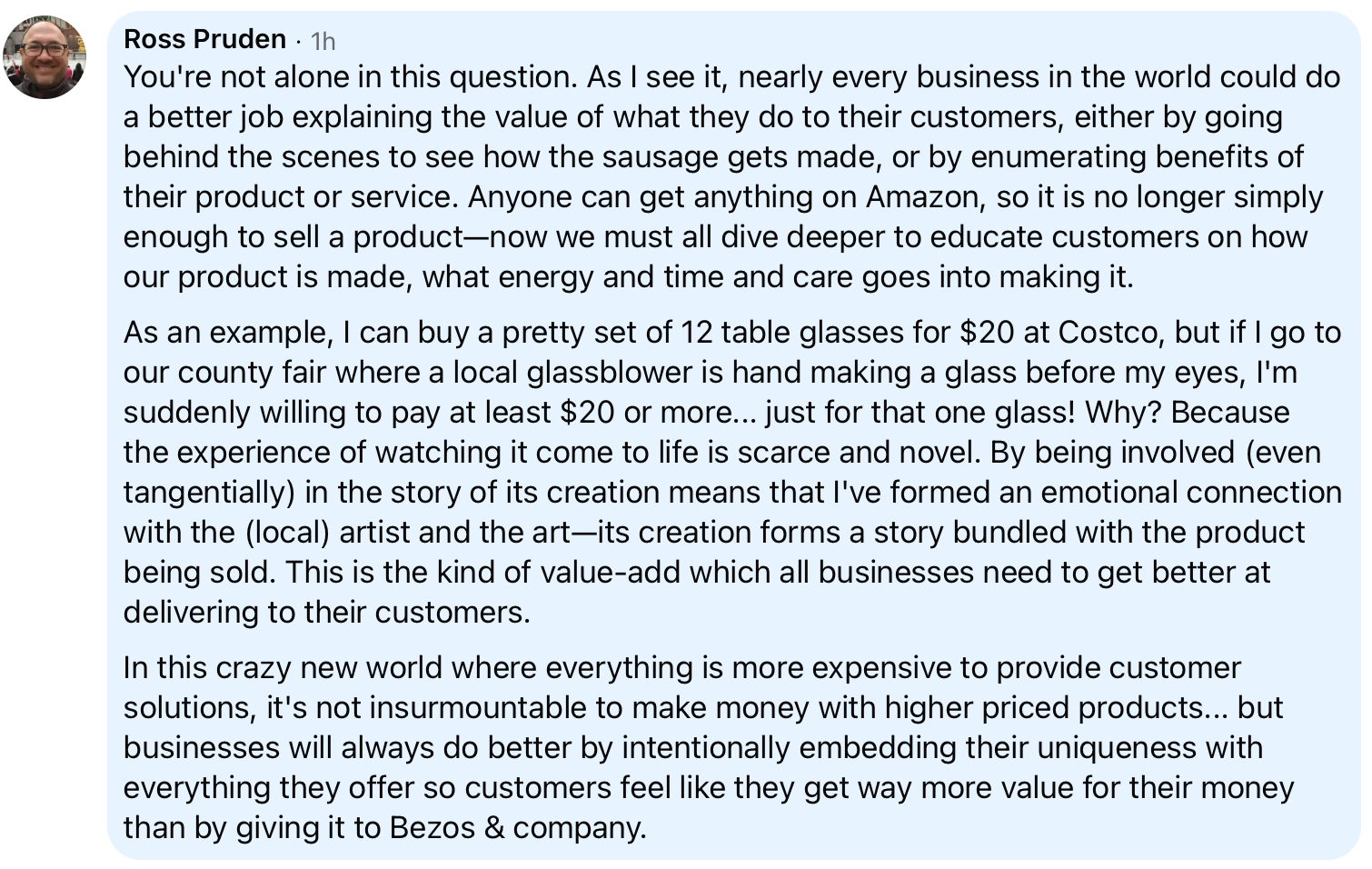
Here is my Facebook reply, which I thought worthy enough to park here:
Whatever business you are in, your job isn't finished after you upload the product onto your web site, or you stock it on a brick and mortar shelf. That's 20th century thinking. That's what we all did when Amazon and Costco weren't ruthlessly competing by saving a customer's money and time. There are new rules now.
New Century, New Rules
In the 21st century, you need to stack the deck in your favor. You need to spend time diving into the story behind the thing you sell. Talk about your 'why', talk about the reason for the product's existence. If possible, make it an emotional journey, too. Make a process video for your web site. Talk about your passion. Show off your products to delighted customers. Get interviewed on podcasts. Be on the lookout for any excuse to explain why you do what you do, and why this product needs to exist.
Lean into your most authentic self and customers will show up to buy a piece of that dream. That is how you compete with a faceless chain selling knockoff copies of your products. In a race to zero, be the company people remember and love to support because they don't just love your product... they love you, too.