case study: running a Meta traffic ad (part 2)
How do you tell if a traffic ad on Facebook selling books on Amazon is working? This case study details that process, warts and all. Part of a series.


I'm running a simple traffic ad on Facebook for 20 days. The objective is threefold:
- See if customers are willing to download a free book on Kindle Unlimited.
- Collect link clicks for an ad retargeting audience later.
- Collect some realistic expectations about conversion metrics, specifically:
- how many people go from Meta's ad to Amazon (Click Through Rate);
- how many people get the free ebook (Landing Page Conversion Rate);
- how many people buy the paperbook version, if any.
It kinda kills me that I don't have an audiobook lined up because I suspect that's where this ad could really help lift sales, but I can't be everywhere all at once. That's a battle for another day.
the ad. and behind the curtain.
I'm using Meta's iPhone app, Ads Manager, which lets me preview what the ad looks like:
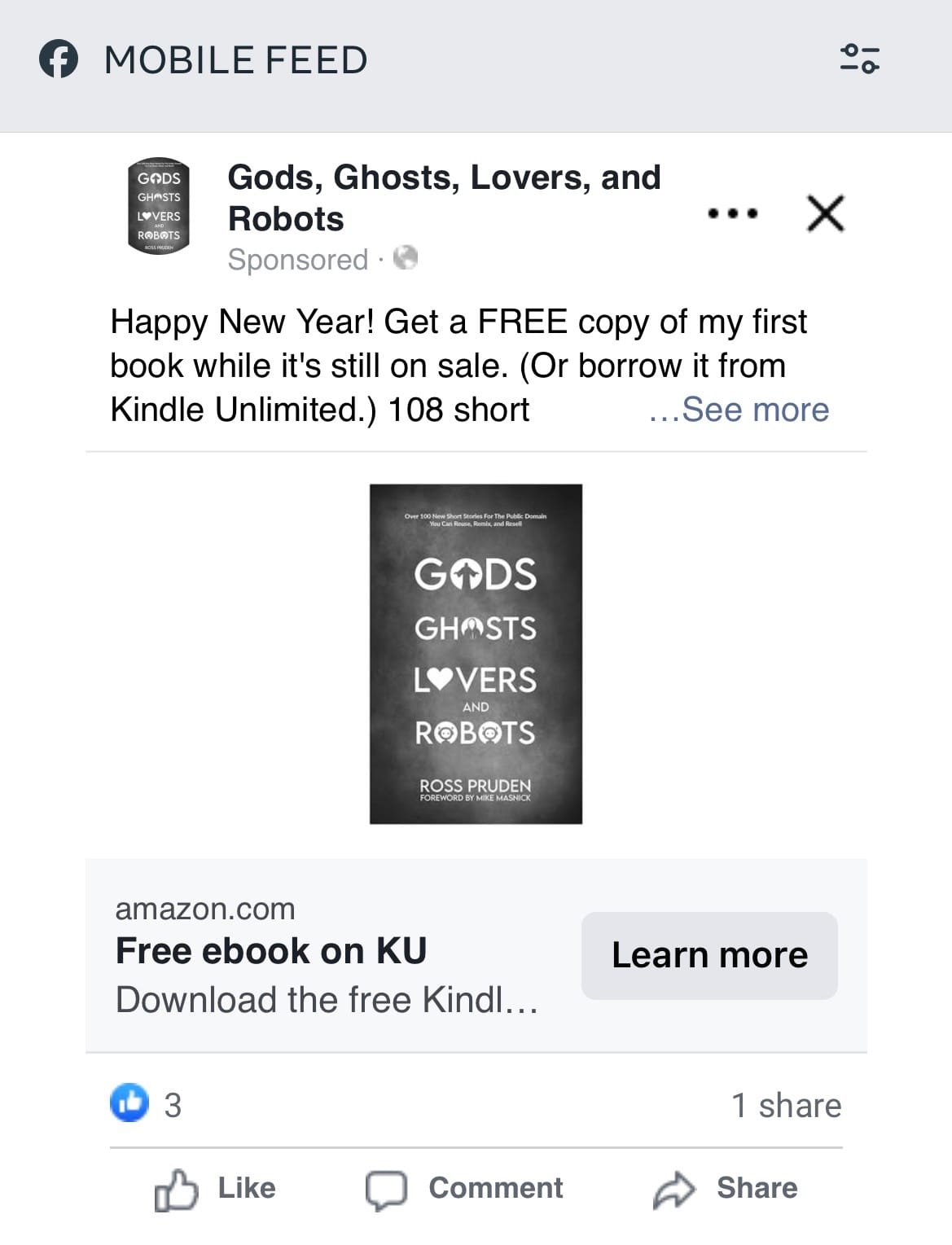
Not the greatest ad, to be honest, but it's good enough to test. Besides, I can always optimize it later, right?
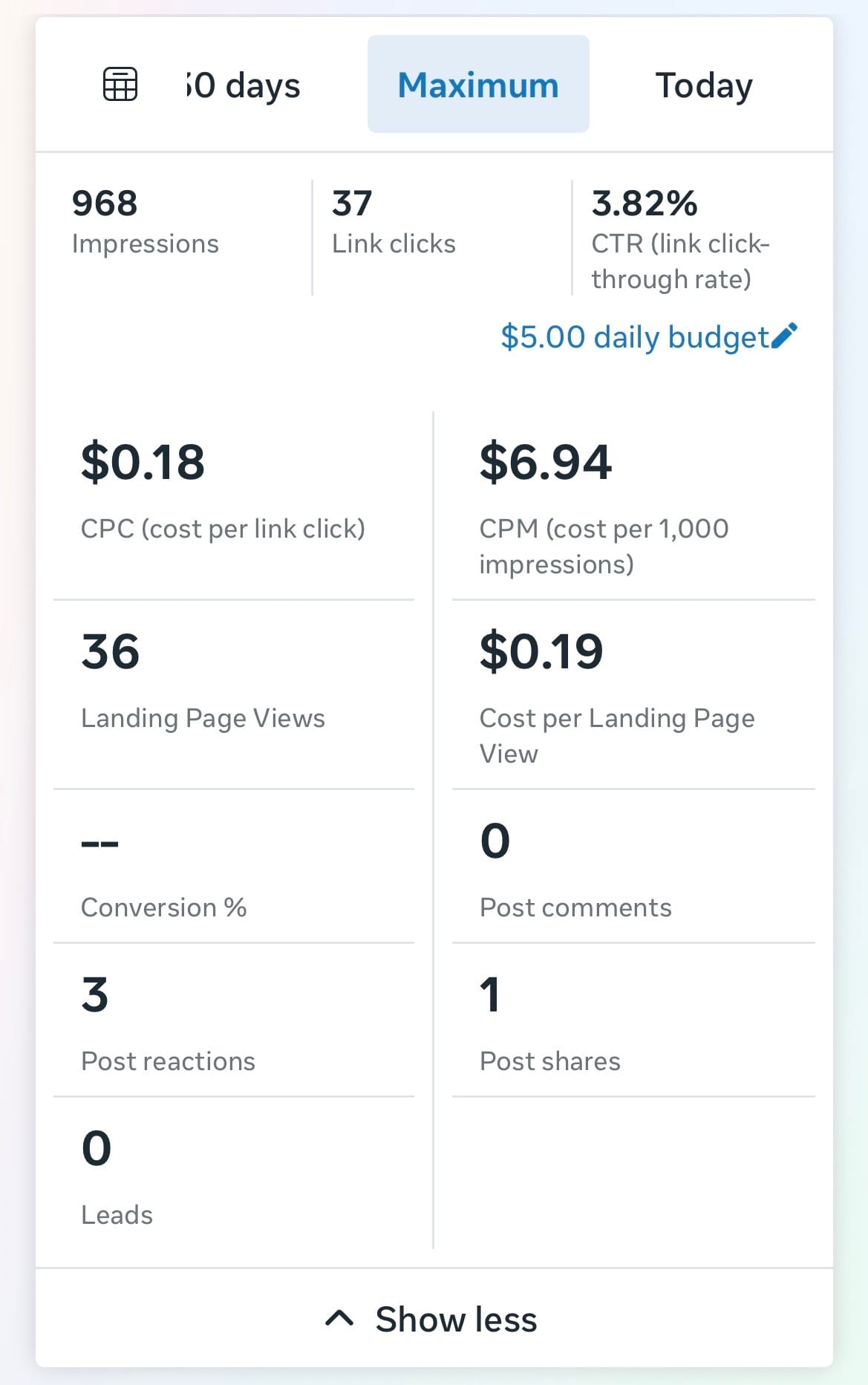
I'm paying $5/day for 20 days. After running the ad for a little over 24 hours, this is what the Ads Manager looks like:
After checking Kindle Direct Publishing for orders, it shows me this:
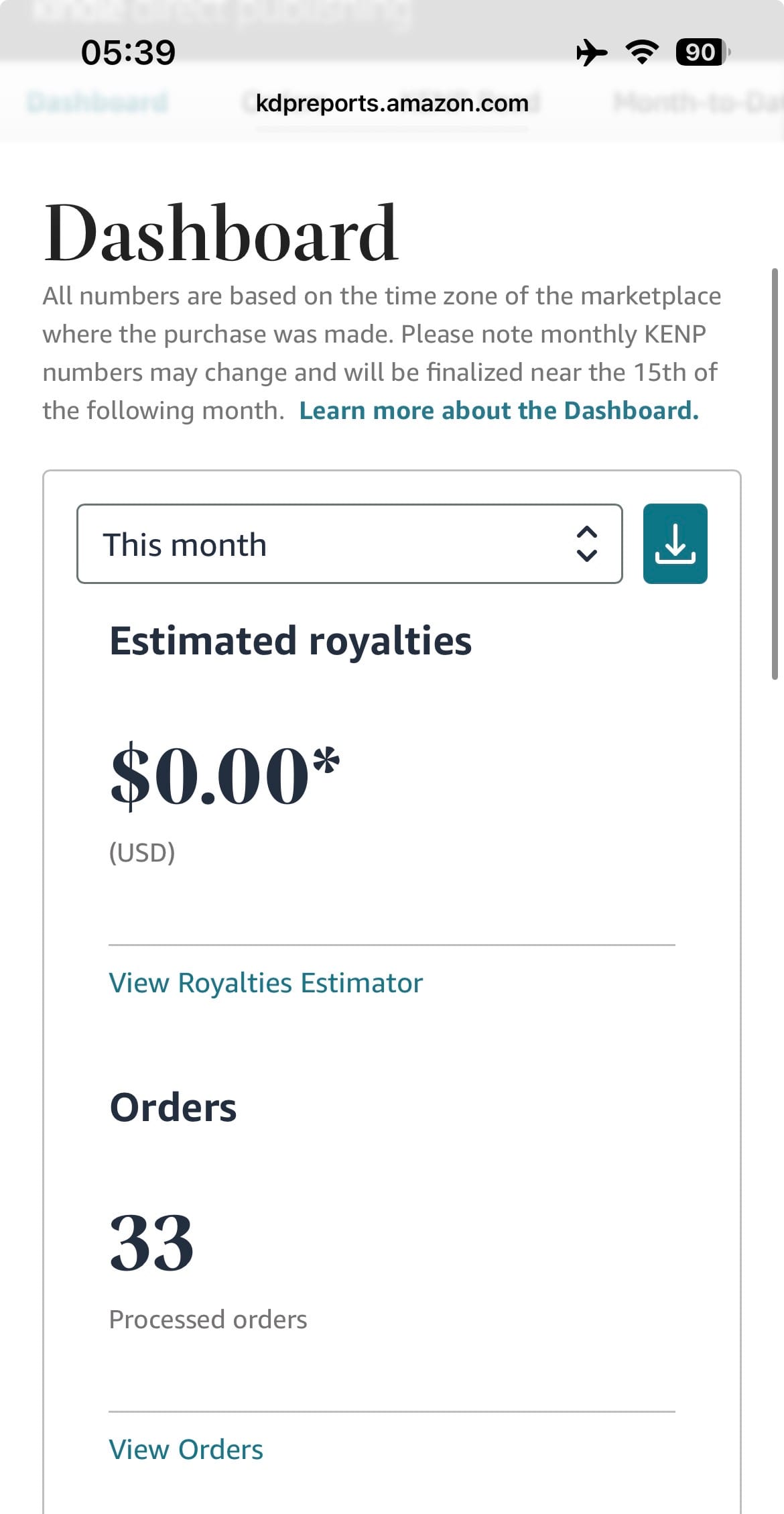
33 orders and no royalties means those are all free eBook orders (technically, only 29 since 4 orders were there beforehand). I'm running Kindle's 5 day Free Countdown Promotion which expires on January 5, which is why I decided to run ads right now.
the spreadsheets. all the spreadsheets.
Now we get to the meat of it. I need to know what my expected numbers will be at the end of 20 days, and to do that, I have to start with the actual ad numbers as a basis. Each day of data further refines the expected numbers.
Generally, my goal is to run a campaign that costs me little to no money. More readers—even free ones—leads to more fans... which leads to true fans. If it costs me some money to stoke that fire, I want to know exactly how much it will cost, i.e., if I spend $100 and make back $75-$90, then maybe I don't mind spending it at all? I mean, my long-term goal is to spend $100 to make $200 (at that point, it's an infinite money printing machine) but we're not there yet.
I like spreadsheets because they help me explain things cleanly, and here's spreadsheet for this campaign. If any of the lines look confusing, just read the right column to get clarification.

my daily tracking steps.
My daily process is straightforward:
- For actual numbers column only, input stats from Ads Manager: total campaign ad spend to date, CTR (links), Link Clicks.
- For actual numbers, input stats from Amazon's KDP: ebook orders, paperback orders, hardcover orders.
- Copy over actual numbers to expected to improve accuracy: CPM, CTR (Links), Promotion eBook Conversion Rate, Paid eBook Conversion Rate, Hardcover Conversion Rate.
- Review Total Profit / (Loss) Expected—is it positive or negative?
observations
I'm noting a few things right at the start:
- My Promotional eBook Conversion Rate is insanely high—over 75% on average. I really didn't expect that at all. I was thinking 30%–40% if I was lucky, so I guess I have a compelling free offer.
- The ad won't be evergreen for all 20 days, which was bad planning on my part. Lesson learned.
- By the end of the campaign, I should have over 400 people clicking over to Amazon, which will be incredibly helpful for retargeting later. Framed that way, $100 is a tiny price to better know your audience.
- This ad isn't even optimized! I was expecting the CTR to be 2%-3% and it's hovering around 4% after only one day. After a week, it's possible it hover around 5%. If I optimize the ad and/or retarget, I might be able to get it as high as 6%-7% or more.
- Once the promotion ends on 1/5, the conversion numbers will look radically different. Instead of 70% free ebook conversion, the profit formula will shift to counting paid ebook purchases and KEPN reads.
- Eventually, this might be an automated process but I like looking at the numbers and adjusting them to get a sense of how an ideal Meta traffic ad might look.
Part 1: Getting Subscribers
Part 2: Running a Meta Traffic Ad
Part 3: Prepping the PDF download (coming soon)