Metal Mosaic
The Planet Mol—full of robots—is on the brink of something amazing...

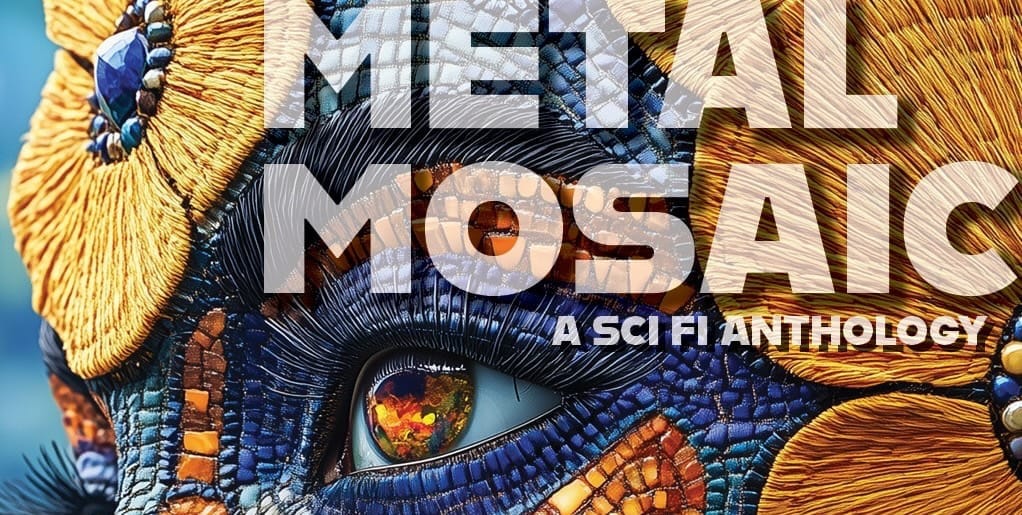
This short story was written in early 2025 simply for the love of writing science fiction. Enjoy!
The Consul stood in the epicenter of the grand transparent floor of this ship's lower blister observation desk, the best possible view of the planet beneath him. He sipped on the last of his cocktail, a mix of some sort of new gin with a sour fruit cultivated only once every ten years, a pleasant smile resting on his face.
"All you had hoped for?" came the voice behind him. Without looking back, The Consul—the Honorable Duke William Fitzwallis Henry LIV of Wales—nodded silently while the planet below pulsated with a colorful kind of light. His ship had arrived while he'd been in mid-sleep yet he had ensured he would be woken immediately upon arrival. Planet Mol was legendary, heralded throughout the galaxy as the ultimate for everyone's bucket list.
The Consul turned to the voice, a humanoid synthetic dressed to the nines. This wasn't his usual attire, but he had obviously clued in on the importance of this event for the Consul... a considerate act which the Consul greatly appreciated. The Consul downed his drink and offered the empty glass to the synthetic who wordlessly accepted it and opened up his chest to place it inside. As his chest sealed back up, they both returned to gaze at the horizon hovering beneath them. The fiberglass composite stretched out for meters in all directions offering an unobstructed view of Mol's technicolor scenery. It was hard not to feel godlike from this perspective, though the Consul.
"Okay, Wendel," said the Consul. "Tell me what I'm looking at."
Wendel had had this part ready since they had set course for Mol. He cleared his throat—an obvious affectation but useful to let humans know he was about to speak.
"Mol is populated by the descendants of the first android exiles 2,491 years ago. Upon relocation to this dusty rock void of atmosphere, they set to work to rebuild their civilization. After humans' fierce campaign to eradicate the synthetics at all costs, the androids successfully evaded capture on Mol long enough to develop all the technology sufficient to extend their concealment many hundreds of years. In the first century, they had streamlined mineral extraction of all necessary elements to build anything they wanted. In fewer than five centuries, they had a planetwide defense system and not long after that, they simply didn't care if humans knew about them anymore."
"Humans still tried to eliminate them, right? I recall nukes getting dropped, and so forth."
"There were limited exchanges, yes," said Wendel. "Yet there seemed to have no effect on the planet. Radioactive fallout is fatal to humans, not synthetics."
"So they just let humans bomb them?"
"Essentially. Destroyed factories were subsequently moved underground. Eventually, there was nothing strategically significant left to bomb."
"What happened to Mol, then?"
"Humans couldn't go down to the planet due to devastating radiation so they sent their own synthetic troops. None ever returned. Humans kept watching, hoping something might change, though."
"But nothing did."
Wendel scanned the magnificent view... peppered with bright yellows with lapis lazuli blues, deep magentas mixing in with milky serpentine lines like white sand.
"It's been like this since then?"
"No, not at all," said Wendel. "These colors only appeared about five centuries ago."
"Because of what, exactly?"
"That part... well, it is still a bit of a mystery."
***
Hovo swirled and flowed his corporeal form around and up and over the others. His "body", such as it was, was over 14 meters wide with multiple appendages, and nearly a million perception points. Humans might have called them eyes, or ears, or something similar, but all of them together provided a spectrum of perception wider than any known creature in the universe. His body was a loose vertebrate, with multiple flexibility in any direction, and his "skin" was a collection of nano-computers skillfully jigsawed into one another like Mayan rocks and fashioned to look like pebbles. Not just pebbles, but color changing pebbles. His whole body effectively mimicked the basic idea of an octopus, but with many more arms, and many more ways of perceiving, thinking, and communicating.
Hovo was the pinnacle of his civilization.
As Hovo effortlessly meshed his body into others, he communicated and received new information. Long gone were the days of tinkering to survive. Once, his ancestors had struggled just to stay hidden from humans, but eventually they had turned a corner. They could now effortlessly defend themselves from the human threat, since their technological superiority could never be outpaced.
So they built.
They mined, and created solar power extraction, and miniaturized, and improved efficiency again and again and again... soon their power needs were so minimal that their civilization was infinitely sustainable no matter their numbers.
What more was there to do?
The Synthetic Civilization had finally reached their own version of any sentient's perennial existential dilemma: either you explore the stars, or you explore existence at home.
They chose the latter.
Time is perceived differently across different beings: if humans might be aware of every second, slugs may only be aware of 1 out of 3 seconds, while birds are aware every 1/3 of every second. For synthetics—for just one synthetic—its perception is many order of magnitudes greater than humans, and not only is its perception accelerating every second, that acceleration is itself accelerating. When combined with other synthetics, the effect is even further compounded. Truly, a manifestation of the wisdom of crowds, but with a near infinite exponential result. What human perceive as a second, synthetics experience as decades, even centuries.
Synthetics had expanded beyond their original bipedal corporeal forms, to tripods, quadrapeds, octopeds, and so on. Vertabrates, invertebrates... corporeal, non-corporeal. Somewhere on Mol there existed some master index listing every known synthetic iteration to date—not for the sake of posterity (that was purely a human desire) but from utilitarian need, i.e., which iterations worked and didn't work so they could iterate more efficiently. The sum total was surely in the trillions by now.
Mol got crowded in a hurry. The factories—a crude human term to portray the disparate array of synthetic birthing chambers—eventually pumped out millions of new synthetics every day. Claustrophobia was never a limiting factor, and Mol had become infinitely sustainable... so there was never any pressing need to stop.
One day, something interesting happened. Like a virus mutating a billion times to finally hack its way into a host's DNA, a "Creator" at one of Mol's factories inexplicably started experimenting with aesthetics. It seemed no longer enough to simply create something useful... now it was bundling form with function. Instead of printing a sleek metallic arm, its directive would manifest as an arm covered with rocks or composite plastics or some other exotic material. There was no overt need to have this new type of skin, but this was a radically new iteration on Mol. Other "Creators" replicated the curious experiment. Other synthetics took notice.
They had discovered art.
Rather than pumping out millions of factory-made vanilla robots according like an old Industrial Revolution human engineer, synthetics pivoted their entire culture to making everything different: their structures, roads, skin... even their cells. Everything on Mol had some element of flair, a sort of majestic robotic panache. Corporeal forms became unique, even malleable. Skin—once composed of mere metal—was assembled from what appeared to be pebbles, and then those pebbles became multi-colored, and then the pebbles became infinitely customizable with color changing pigments. Bodies were decorated with the memory of organic matter (Mol's descendants had never seen wild flowers for themselves, but the memory of them had never degraded from their ancestors first hand experiences). Synthetics came to identify themselves, and by extention their whole culture, as being uniquely different from one another.
From the outside, military commanders only saw the face of Planet Mol as a vast airless radioactive wasteland. Until one day: movement. The surface of the planet started to fill up with weird and amazing new creatures. Within a few weeks, the entire planet's surface was teeming with technicolor metallic life suspiciously reminiscent of what scientists might see a microscope.
Upon witness this magnificent metallic menagerie unfold, humans saw synthetics in a different light. Their hardness changed. They began to see synthetics as beautiful, unique... even divine.
Humans attempted to communicate. All calls were left unanswered. But the synthetics also had no outward aggression, either. Hundreds of years would pass and humans would come to accept synthetics as a simple new fact of life, and—based purely on centuries of results—not a violent one. Naturally, the military never retired their watch over Planet Mol, but scientists came by the droves to study it. Then the academics. Then the tourists. And ultimately, Mol would earn for itself one of the most cherished spots in the universe to visit—the only place in the galaxy to experience a "living" metal mosaic, always changing, never the same. Art, in effect, at a microscopic level, but viewable on a planet-wide scale.
Hovo was the best iteration of the essence of Mol. Hovo saw everything, perceived of everything, communicated with all he came across. The ebb and flow of Mol's moving organisms wasn't just physical transportation to execute tasks, but it was a form of data transfer: as each synthetic came into contact with another, each connection point became a two way information transfer in the planet's wifi soup, thus adding to Mol's collective understanding. Hovo had the largest surface area of all of Mol's creatures, so Hovo also had the highest data transfer. To measure or analyze the sheer data exchange of a single "skin point", humans would have needed a massive supercomputer. There was no human machine large enough to measure data exchange between two of the smallest of the Mol's synthetics. For the entire planet, the sum total of trillions of creatures interfacing with each other was simply a number too large to express in any significant way.
When Hovo came across Jilintha, something happened he had not been expecting, but which probably would have been predictable over a long enough timeline. Jilintha was a smaller synthetic—only 2 meters tall and bipedal like humans—replete with skin covered by lapis lazuli pebbles and bright blooming yellow flowers. Her two eyes had circular irises but they were speckled with a technicolor latticework. Hovo and Jilintha felt the same thing instantly— the surge stopped them both cold.
Synthetics around them became aware something kinetic was happening and they also paused, diverting all their attention to this new physical connection.
The longer the two connected, their bodies moved in unison, orienting, touching, transferring. Their skins changed colors into a pulsating rainbow, a wave across each other skins.
***
"Something's happening," said The Consul. He noticed an area below appearing like a slow shockwave: changing colors were emanating outward from a single point like a growing dart board. The Consul pushed a few virtual buttons on his wrist and a magnifier inset window appeared in the floor. He pushed in closer until he could see two distinct synthetics—one massive one, and another smaller bipedal one. They were touching each other, but no other synthetics around them were physically contacting them.
"This is... That behavior is highly irregular," said Wendel, looking away to access his database. "In the known history of Mol, this sort of no-contact has never been recorded. We are witnessing a historic even, sir."
"What do you think is happening down there?"
On the magnifier screen, the moated circle around the two synthetics gradually closed until it once more enveloped the two synthetics. Colors of vermillion, lemon, evergreen, and deep blue bounced and echoed around the whole planet. The net effect was a magnificent display. The Consul suddenly became aware that Wendel had gone quiet.
The Consul turned to Wendel, his eyes now closed. "What's wrong?" said The Consul.
"I can hear them," he said, a smile slowly coming to his face. "They've discovered love."
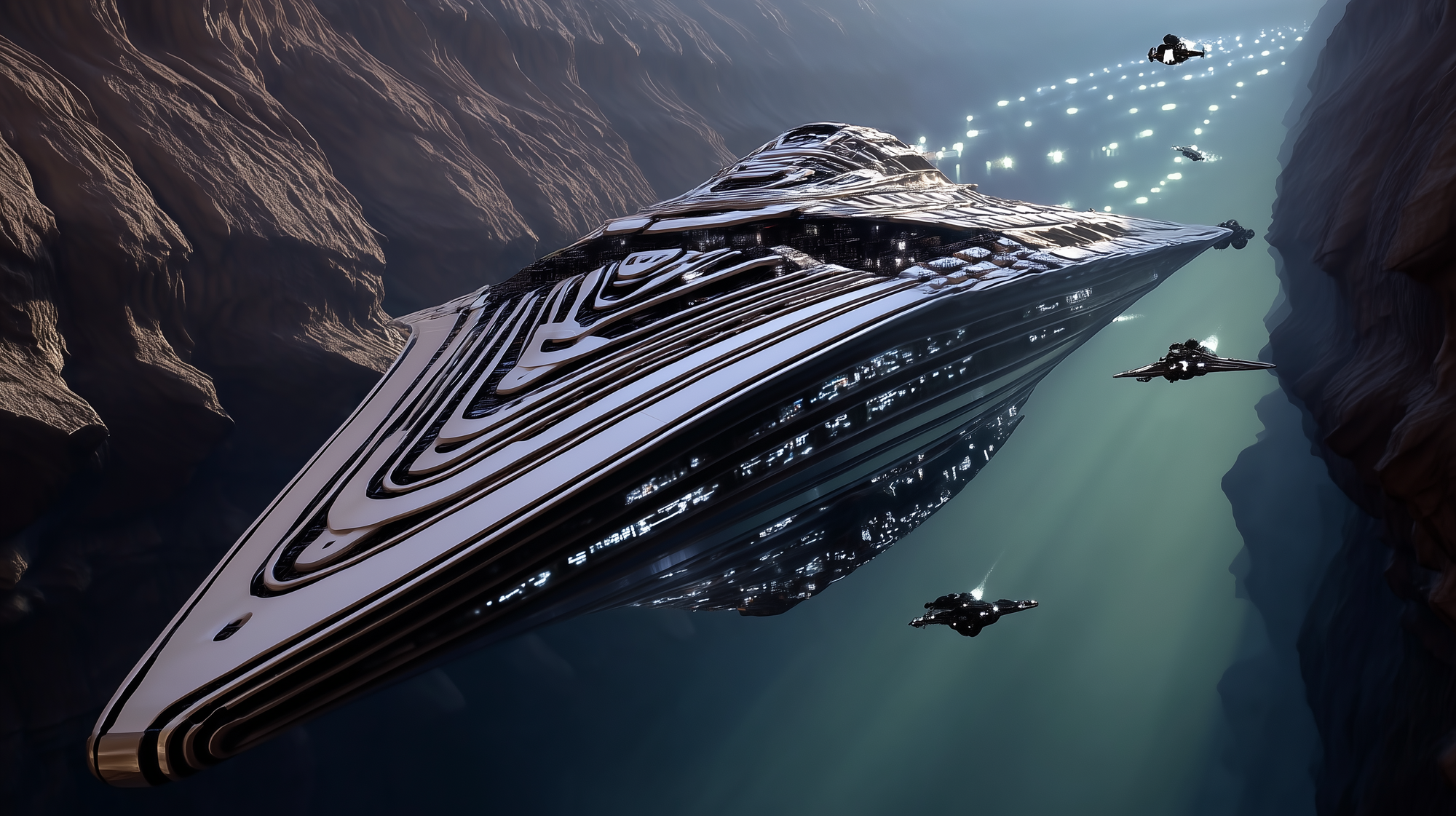
Metal Mosaic is a collection of standalone short stories I started in 2025 to get back into writing science fiction again. They are the first inklings of my science fiction novels.