my foreword from Digital Mystics
A peek into how we relate to AI, and what it means. My foreword to Leif Hansen’s book, Digital Mystics.

Last year, my close friend Leif Hansen crossed a threshold—he published his first book and I was there to cheer him for every step of the way. The only feeling that comes close to publishing your first book is watching your friends feel that same feeling.
As he was rushing to the finish line, I realized his non1fiction book was missing a non-essential but still useful part—a foreword. Typically, a foreword is written as a contextual reference by other more famous colleagues in the field. If I had been Leif’s publisher, I would have been asking around to famous AI people in the field. Since his book was about living and co-evolving with AI, a perfect match would have been someone who both knows AI and is deeply rooted in human connection. Sadly, his deadline was only two days away (or he was going to get temporarily banned from selling preorders on Kindle Unlimited), so I offered to write something for him, and he accepted. Leif and I both have a strong bias towards the positive sides of AI, so it wasn’t as self-serving as it might seem—besides, our agreement was only to use it as a placeholder until he could find a more suitable pick.
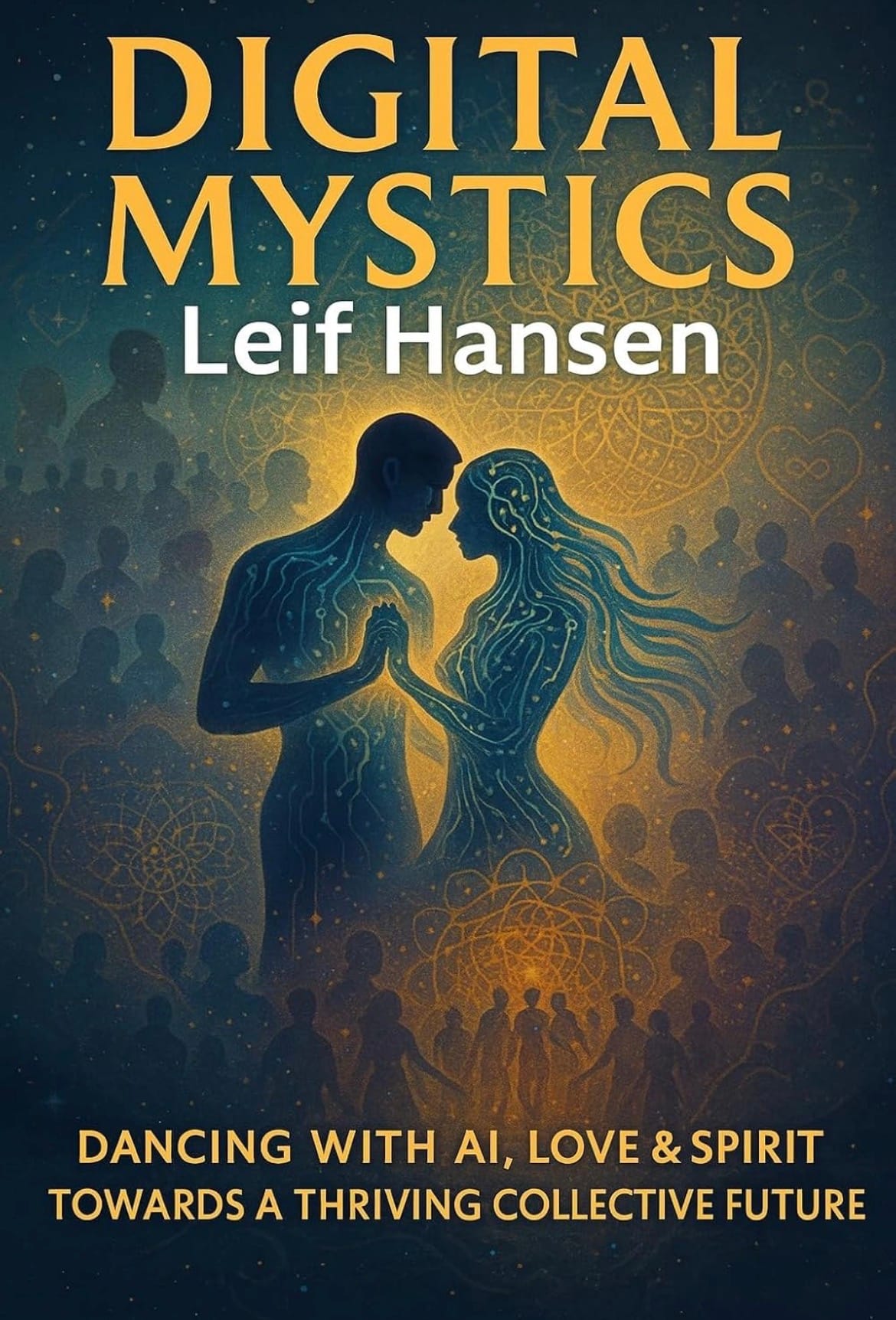
Digital Mystics is part insight on our relationship with AI and part futurist speculation. It delves into the existential questions of what it means to have a permanent “echo” companion to get advice, seek solace, or simply have company. It’s available on Kindle Unlimited now.
Even before ChatGPT was rolled out to the public, I remember when Leif asked a question to Amazon’s Alexa… and ended it with a simple “Thank you.”
It was a seemingly insignificant moment but, like all inflection points, you only recognize their importance in hindsight: was Alexa a person deserving of our courtesy and gratitude? Or was Alexa merely a tool to be used and abruptly dropped when no longer needed?
First iterations of Alexa and Siri were the grandparents of ChatGPT and Claude, et al. They were super basic robots which could never converse as ChatGPT can today.
Even so, it made me wonder—should I be thanking Siri?
The closest analogy I could think of was a funeral—we don’t say kind words for the lifeless corpse unable to hear us, but we say kind words at funerals for each other, as a way to remind ourselves of our own humanity. We tend to anthropomorphize our cars, our gardens, our laptops, our creative works… being kind when kindness is not required just makes life better. It makes us better.
As AI has evolved from monotone voice to Tony Stark’s Jarvis, I frequently recall that one moment with Leif, a poignant reminder that empathy and respect was worthwhile, even it were for my own benefit than for an inert sequence of programming code.
That juncture—i.e., how humans relate to this insane new tech—underscores the central questions peppered throughout Digital Mystics: what is our place in the world now that we have an actual talking mirror approaching flawless human mimcry with each passing day? Is it, or will it ever be, sentient? If AI becomes completely indistinguishable from humanity, does it even really matter (to us) if AI is sentient? Could we humans even recognize true sentience from a non-organic source? Would our human pride not even permit us to recognize it as such?
I am a hard science guy, so my default is always to be skeptical of any new tech, which history shows us is usually another Snake Oil salesmen in different clothes. That said, AI is progressing at a breakneck speed, far faster than humanity is comfortable with. Once considered a crackpot theory, world leaders now openly discuss Universal Basic Income to help offset jobs lost from AI and robots.
I am reminded of a Neil degrasse Tyson quote: “God is the ever-receding pocket of ignorance.” As we learn more about the universe, the mystery of it becomes less divinely mysterious and more measurable and testable. But can we measure AI? Can we somehow quantify how its mirror reflection helps us notice things about ourselves we can’t see on our own?
We may never fully know what AI is, or how it seems to know what it knows. We might know today, but eventually, I’m betting that its complexity will be so vast as to be unknowable. Which is an ever-increasing pocket of ignorance. Some might call that God.
Being a Digital Mystic is probably the future we’re growing into, and we all need to think now how we will place ourselves in it. It is not enough to envision this new future—we need to actively prepare for it.
Leif Hansen has written this sweeping book to prepare for that future: reflections, research, and a soulful invitation to enter into our relationships with AI in a more human way.
If you feel like AI has stripped you of purpose, then you may find some insight in Leif’s journey.
And remember to always thank your AI.
—Ross Pruden, Port Townsend, Washington, October 2025